

Once again, we enter the spacious main hall of Vantaa’s own art museum Artsi in Myyrmäki. The humid warmth of the early summer is replaced with air conditioning, brightly colored walls and echoing whispers of careful anticipation. The fifth edition of One-Day Stand, a day event of performances initiated by The Other Side Performance Art Platform, is about to come to life.
A gentle-looking person wanders around the space. Jani Petteri Virta raises his finger as if politely inquiring whether it might be a good time to start. What exactly is going to begin, nobody knows – probably not even Jani Petteri Virta himself. He pulls out a balloon, then another one, then another – yellow, black, red, light pink, flapping pieces of rubber. One by one he fills them up and then let’s go. The confused bursts of laughter are accompanied by the comical whining of rapidly emptying balloons. Timer goes off, and the first one-minute performance is over. Jani Petteri Virta walks away hastily, like he has to be somewhere very, very important.
But the tone is about to switch dramatically. What becomes almost painfully evident is how performance art can embody both lightness and unbearable heaviness, and most of all the ambiguous, ever-so-slightly switching combination of the two. We will see this flickering take place in many of the night’s performances, as well as in the spaces between them.
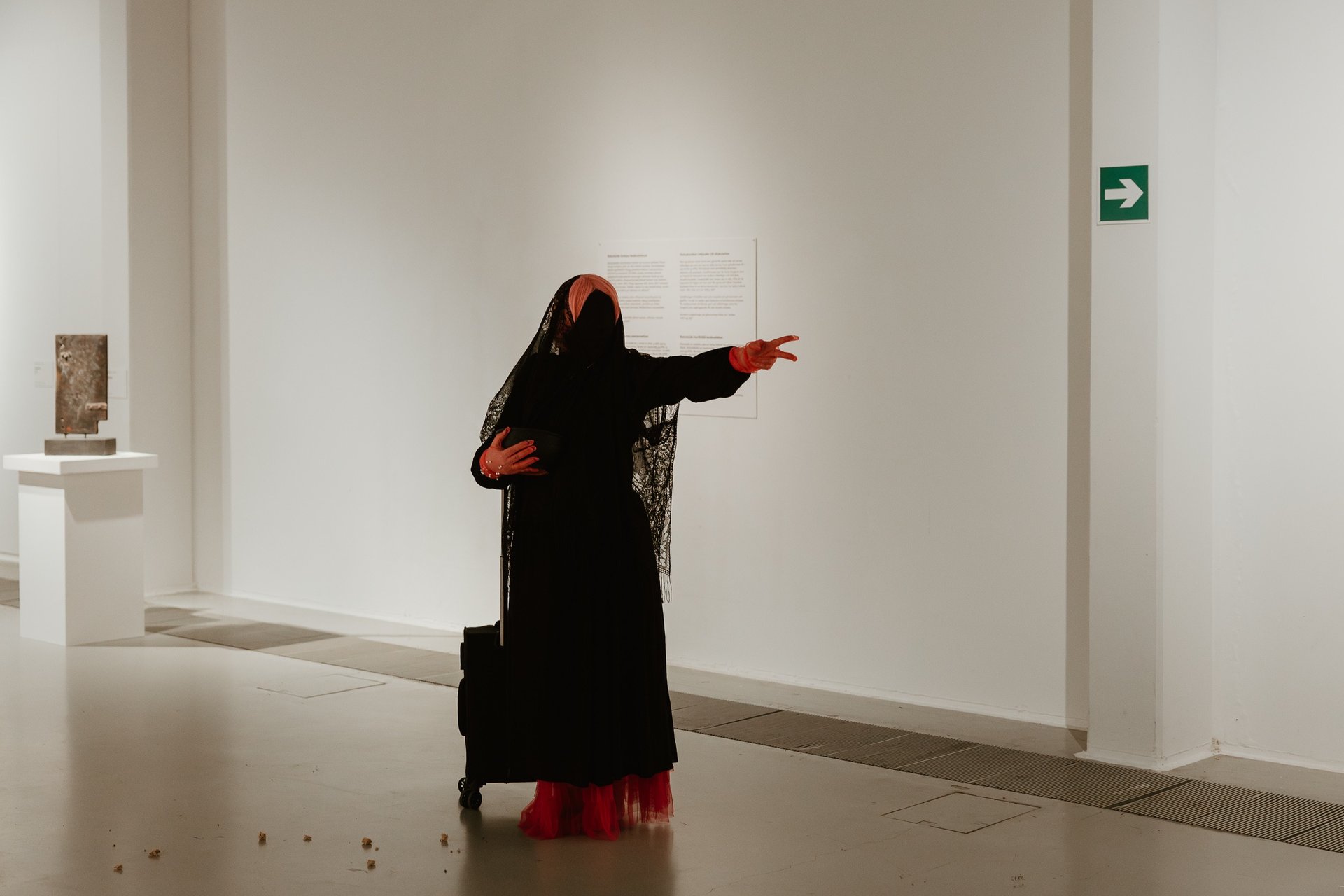
There is darkness, then a door opens. It is the door usually used only in emergencies, when exiting the building as quick as possible becomes a matter of urgency, of life and death. We see a person dressed in long drapes with a black veil hanging over their face enter through the door, from the void-like darkness of some mystical outside, not part of this world, this now-and-here. The black veil works as a kind of void of its own, covering the individual but opening thousands of possibilities for (un)relation. It is perhaps no less a situation of emergency.
Vera Boitcova walks around the hall in patterns that at first seem random but later turn out to lead to very specific points in the exhibition space. These points both represent the politics of different spaces – especially the politics of entrance and exit points of institutions of different kinds. Boitcova talks from a perspective of a queer migrant emigrating from Russia. Through a walking tour of the museum-as-institution and its doors, signs and other signifiers of control, allowance and refusal, Boitcova tells us stories about the different entries and exits of their life as well as about the times these institutions have failed the people they are vowing to protect. We are invited to look at these seemingly
neutral pathways of the museum that in reality hold all the power to make someone (not) belong, that can be used to invite someone in or completely deny their entrance – deny their existence.
On her way, Boitcova keeps leaving traces behind. Lines of breadcrumbs start to sketch a peculiar map on the floor, a strange and dark union of Hansel and Gretel. Once the performance is “over” and Boitcova exits the final door of the institution only to immediately enter it again, the breadcrumbs remain, but not to show the way home. They exist only as breadcrumbs, and someone needs to clean them away. Boitcova does, again making visible the usually hidden labor operating behind these institutional settings.
The polite person, familiar from the first performance, seems to be in turn again. This time Virta places a log of birch wood on the floor and starts wrapping it with iron wire, like preparing a sad but silly Christmas present for an evil child. Out of the wire he also crafts a dangerous-looking spike on top of the log, and just as the timer starts going off, attempts to sit on it. A tingling combination of amusement and a peculiar kind of compassion-infused sorrow is present in the air. The jump from the previous performance’s atmosphere suddenly does not feel so radical anymore. The ambiguousness of “it all” is present again.
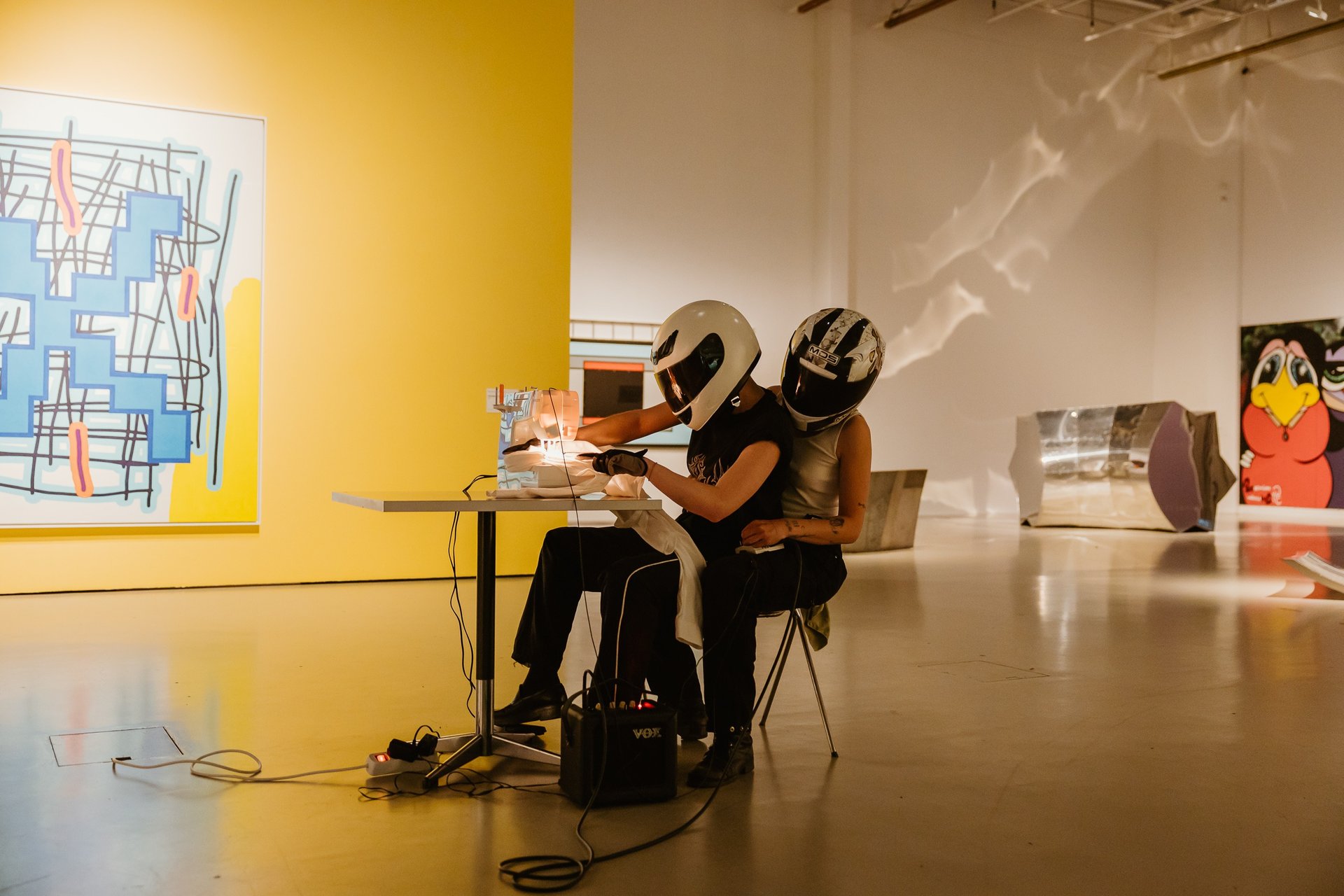
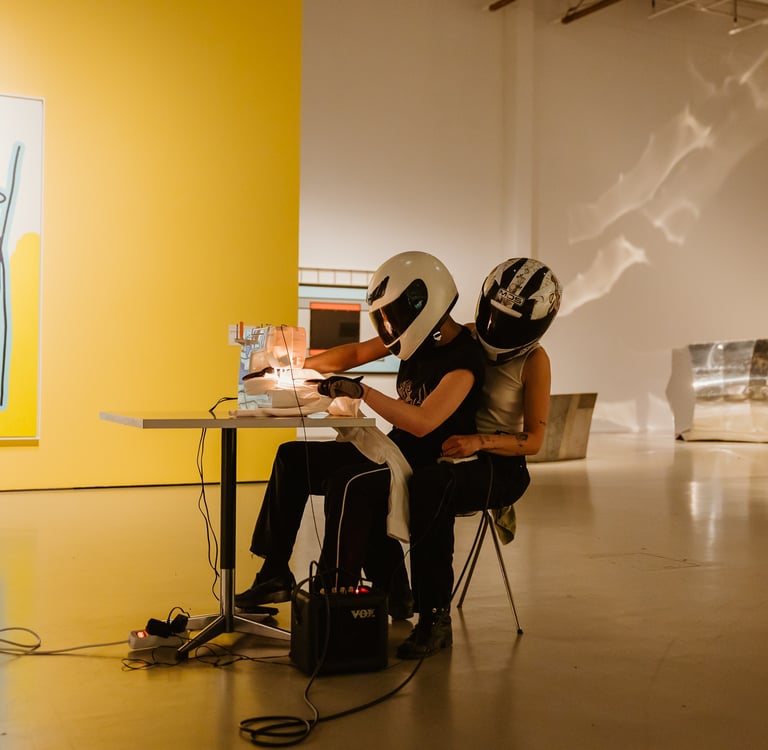
A break in between performances always invites a peculiar feeling of not being quite sure what to do with one’s body. But soon, to everyone's relief (I imagine), Olga Laine and Lisa Holmén arrive in the exhibition hall with their heads covered in giant motorcycle helmets. Suspense and danger fill the air, accompanied by a specific kind of curious humor that feels like a breath of fresh air. Suddenly you don’t have to know what to do with your body, the tension holds it together in a slightly reverberating stillness.
Laine and Holmén start the performance by getting their equipment, a white sewing machine with its proper extensions (obviously one needs a sound effect pedal to go with a sewing machine), ready and good to go. They polish, they examine, they hover around giving in to an occasional slap. It is a gentle collision of two familiars, two domestics – two heavily gender-associated activities of sewing (which is also a commonly downplayed form of feminine labor) and motorcycling (that on the
other hand is perhaps not a form of labor but rather a masculine mid-life crisis postponement with associations to poor action films – but also to extremely cool feminine outsider heroes). At the same time, they are both forms of DIY-culture and sort of modern outsiderism.
A small contact microphone is attached to the machine. On the other end of the microphone cable there is a guitar pedal offering a selection of delicious effects. Laine and Holmén sit on a chair together, put on their gloves, and ride. For minutes on, the echoing hall is filled with heavy distortion and reverb making the domestic tapping of a sewing machine barely recognizable. Occasionally they slow down only to speed up again. You can almost feel the chilling wind of freedom against the skin, the soundscape starting to resemble its roars.
It is witty, funny and weirdly touching, all at the same time. Holmén and Laine turn the conceptions of masculine and feminine work around by creating something gender-bending and provocative. Their physical closeness evokes feelings of intimacy related to sharing the burden of labor that goes unseen and unappreciated.
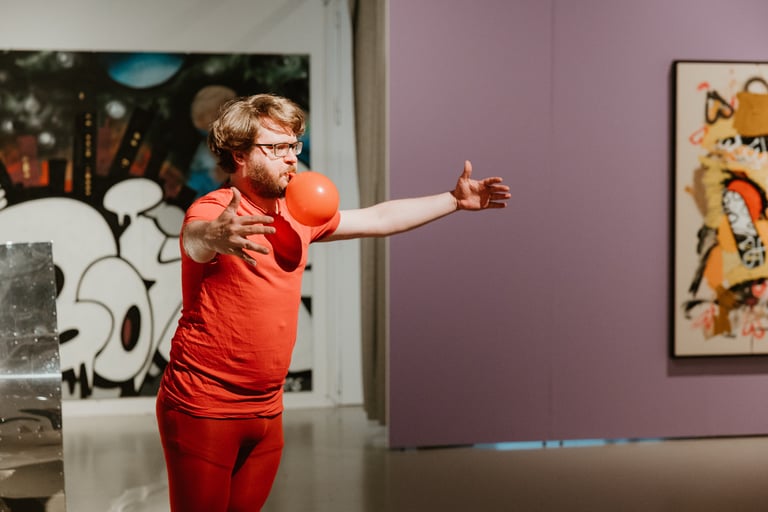
Jani Petteri Virta is now dressed in all red, like a re-imbursement of one of his balloons earlier on. Pieces of Lego clink and clatter on the floor. Virta decisively steps on them and takes a position, like getting ready to pose for a session of croquis. And there it is again, a real balloon. Red rubber filling with air in what looks like a painful exercise of discipline in ridiculousness; an absurd ballet. Virtuosity in awkwardness.
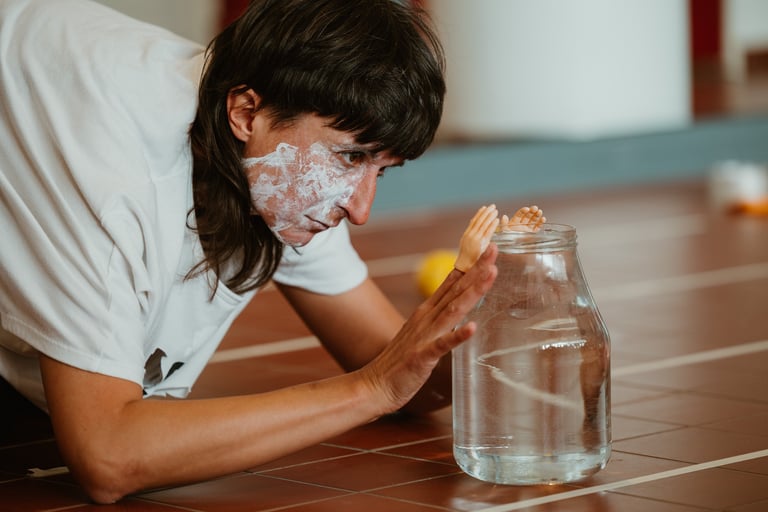
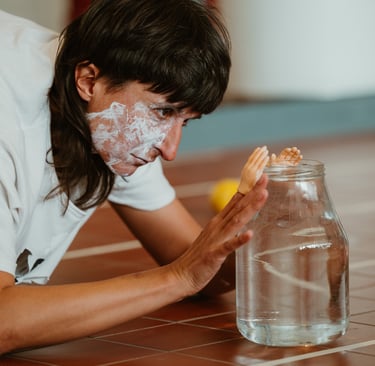
The fourth performer of the night is Marita Bullmann. Together we take root in the entrance hall of the building, and Bullmann immediately gets intimate with the glass wall. Hands and sounds are quickly taking the leading role of the performance. In another hand, Bullmann holds a mysterious canvas bundle wobbling from a weight that in a second turns out to be five lemons. They spread on the tile floor striped by early summer sun and masking tape, forming a Matisse-like composition of bright colors and playful shapes.
Bullmann has scattered in front of her a full-blown arsenal of a performance artist – a water jug, plastic bucket, duct tape. In her shirt it stands in tall loud letters: ACT LIKE YOU KNOW. By
covering words Bullmann forms combinations that communicate in different ways; the sentences encourage us to act, to know, to like. Bullmann then presses a paint marker on her face, and white paint starts dripping down her face, her shirt, under her shirt. LIKE YOU
Bullmann takes out scissors and starts cutting letters out of her shirt. The words are then arranged on the glass wall – ALIVE
Next, Bullmann draws out two tiny plastic hands that fit perfectly at the tips of her index fingers. The hands turn into the headliners as they feel their way through Bullmann’s face, tendons of the neck, peek through the holes cut in the shirt and finally dive into the water jug. Children’s entertained whispers set the rhythm for the slow-paced searching of the hands. The hands start to move the water jug towards the plastic bucket with determination. Now the bigger hands take over and pour the water into the bucket. The hands grasp and find two lemons; feet step in the water bucket. The squeaking of feet against wet plastic, the enchantingly bitter smell of lemon as Bullman’s nails dig deeper under the yellow skin, the quite rain of juice on tiles. The last letters are attached to the wall. ALIVE OU? Is it French? Alive OR? With the smells and the sounds, I certainly do feel alive and crisp.
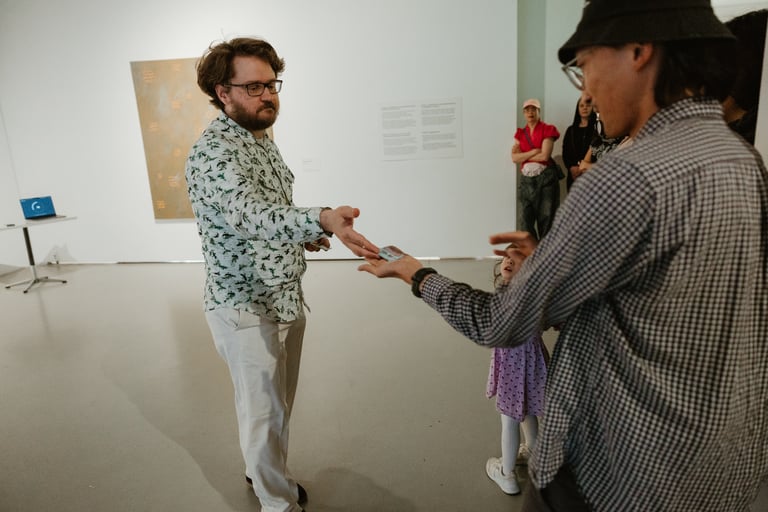
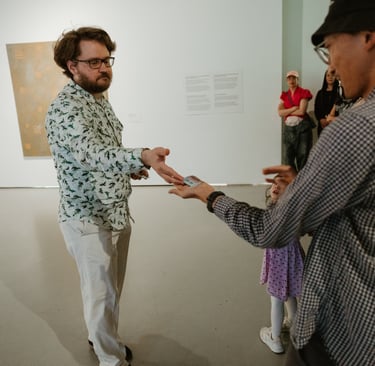
The last one-minute performance turns into a heated whisper debate, when Jani Petteri Virta, after setting the one last timer, takes the position of a tactfully retreating consultant. He takes out a five-euro bill and cuts it in three pieces, giving each to one audience member. After a moment of confusion, the debate is fully on, and the almost-bill-owners come together (money finds money). But the timer doesn’t show mercy, and it remains questionable whether in this case the minute was too short or too long of a time. And that’s what makes the interaction ever more delicious. I wanted to know. We always want to know. What would have happened? What would have happened, when Virta had run out of air with the balloon earlier, or tripped over the Legos when his feet got tired? What would have happened if Virta had had the time to sit on the iron spike? (Well, the answer to that one may be obvious.)
I find something quite essential to performance art in each of the performances of the summery night, as well as in the curatorial whole they create. There is virtuosity in performing virtuosity. There is virtuosity in making visible these underlying, implicit causes of virtuosity – the ridiculous, the useless, the unexplainable combination of joy and despair. There is virtuosity in finding alternative ways to share knowledge, in pointing out the implicit in the ways we usually do. There is virtuosity in being in the state of awkwardness, fragility and openness that performance requires. There is value in confusion and in not knowing, as much as we would like to know. I leave with a curiously light heart, bubbling in my chest.
THERE IS DARKNESS, THEN A DOOR OPENS
A Review of One-Day Stand No. 5
By Maija Suominen